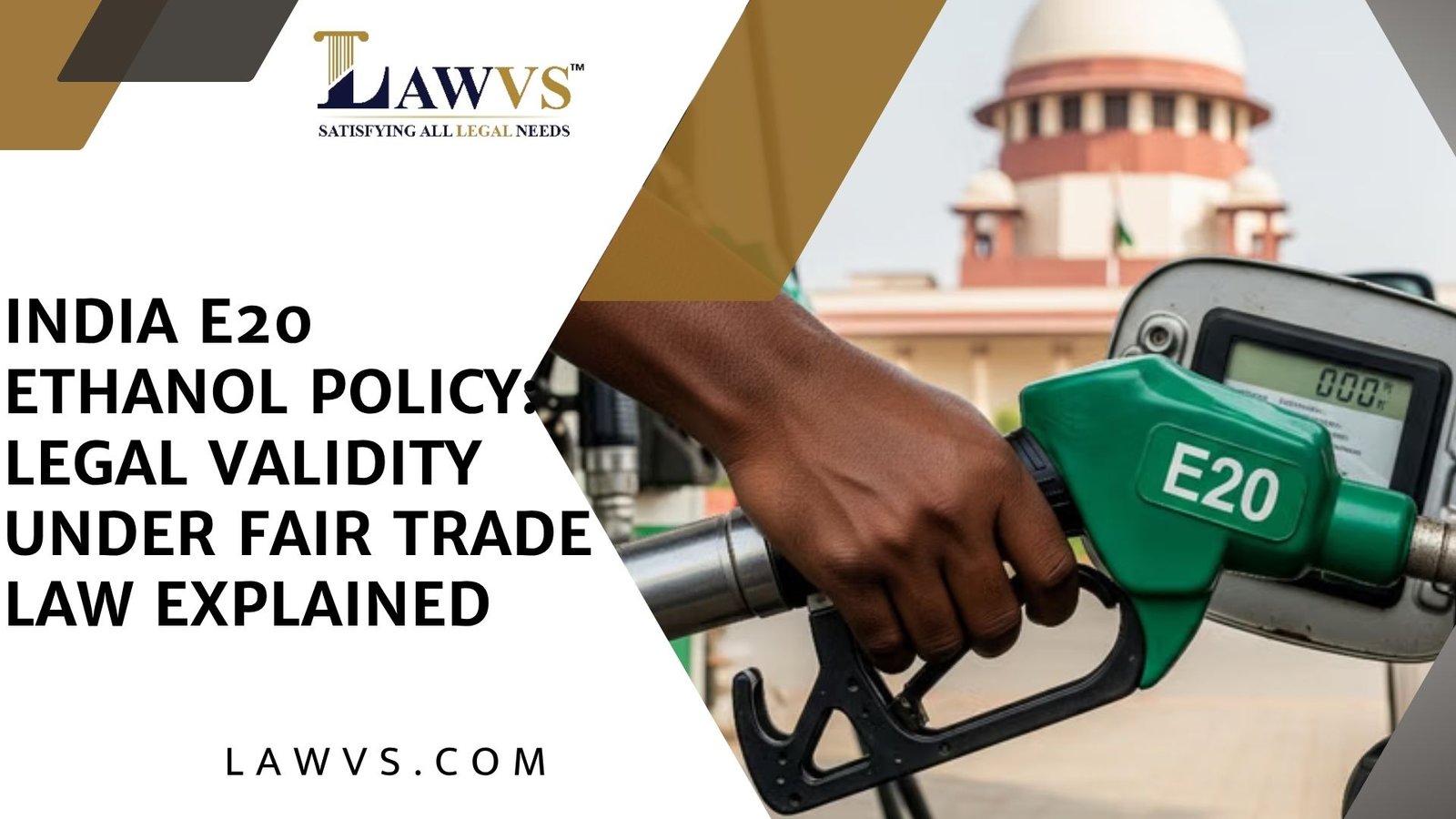
Fueling the future or forcing change? Are 20%
Ethanol mandates valid under fair trade law?
Introduction
As India accelerates its transition towards cleaner energy, the governments push for 20% ethanol blending in petrol (E20) has emerged as a key policy milestone. While the move aims to reduce carbon emissions and dependence on imported crude oil, it has also sparked a critical legal debate: does such a mandate align with principles of fair trade and market freedom?
Background:- The Road to E20
The roadmap for ethanol blending in india ( 2020- 2025) was formulated by NITI AYOG to achieve energy security.
1. Target Advancement : Following the successful achievement of 10% blending ahead of schedule, the 20% goal was brought towards to 2025-26.
2. Fuel Composition : E20 involves blending 20% ethanol with 80% petrol, with the government mandating a minimum research octane number (RON) of 95 for E20 to ensure engine performance.
3. Current status : As of 2025, India has begun implementing E20 nationwide with mechanism for limited exceptions in specific regions.
Key problems:
The rapid rollout faces several operational and consumer- centric hurdles:
1.Fuel efficiency drop: Using E20 in vehicles designed for lower ethanol blends can result in a 3-7% reduction in fuel efficiency.
2.Market distortion: Governments mandates may:-
- Force oil companies to procure ethanol regardless of market price.
- Limit competition from alternative fuels.
3.Engine and fuel system corrosion: Older vehicles (pre-2023) may experience compatibility issues, including degradation of rubber and plastic fuel system components over time due to the corrosive nature of high ethanol blends.
The legal framework and fair Trade Debate:
Are 20% ethanol mandates valid under fair trade law? The legal standing in India hinges on national policies geared towards public interest and environmental safety, rather than consumer- choice based fair trade conventions.
- Government Authority: The government derives its powers from the Industrial ( Development and Regulation) Act, allowing it to amend regulations to facilitate the interstate movement of ethanol.
- Supreme Court position : The Supreme Court of India dismissed petitions challenging the nationwide rollout of E20, allowing the policy to proceed.
- Fair Trade Perspective : While consumers may experience forced changes (higher fuel consumption, potential vehicles issues), the policy is framed under “environmentally sustainable trade,” which often overrides conventional consumer choice laws in developing economies.
- Exception Clause: The government has reserved the right to allow exceptions in special situations, for specific regions, and for a limited time.
Future Outlook and Challenges
- E30 and beyond : As E20 becomes the new normal, discussions are already emerging regarding 30% blending (E30) and advanced biofuels.
- Food Security Concerns : Large- scale diversion of food grains ( rice/maze) for ethanol production requires careful management of domestic food security to avoid food price inflation
- Vehicles Compatibility : A swift transition requires automakers to manufacture all new vehicles as E20- compliant by 2026, which may affect the sticker price of new cars.
Comparative Perspective:
Countries like:
- Brazil ( high ethanol usage)
- USA ( corn- based ethanol policy)
Have implemented similar mandates , but often face legal scrutiny and trade disputes, highlighting the delicate balance between environmental policy and trade law.
Conclusion:
The 20% ethanol mandate is a bold, high-stakes move for India, prioritizing long term environmental sustainability and energy independence over short-term inconveniences. While it passes the legal test in India due to governmental authority in the public interest, it remains a contested topic regarding fairness to consumers and the longevity of older vehicles. The success of this transition rests on balancing the aggressive blending targets with infrastructure readiness and ensuring it does not compromise food security.