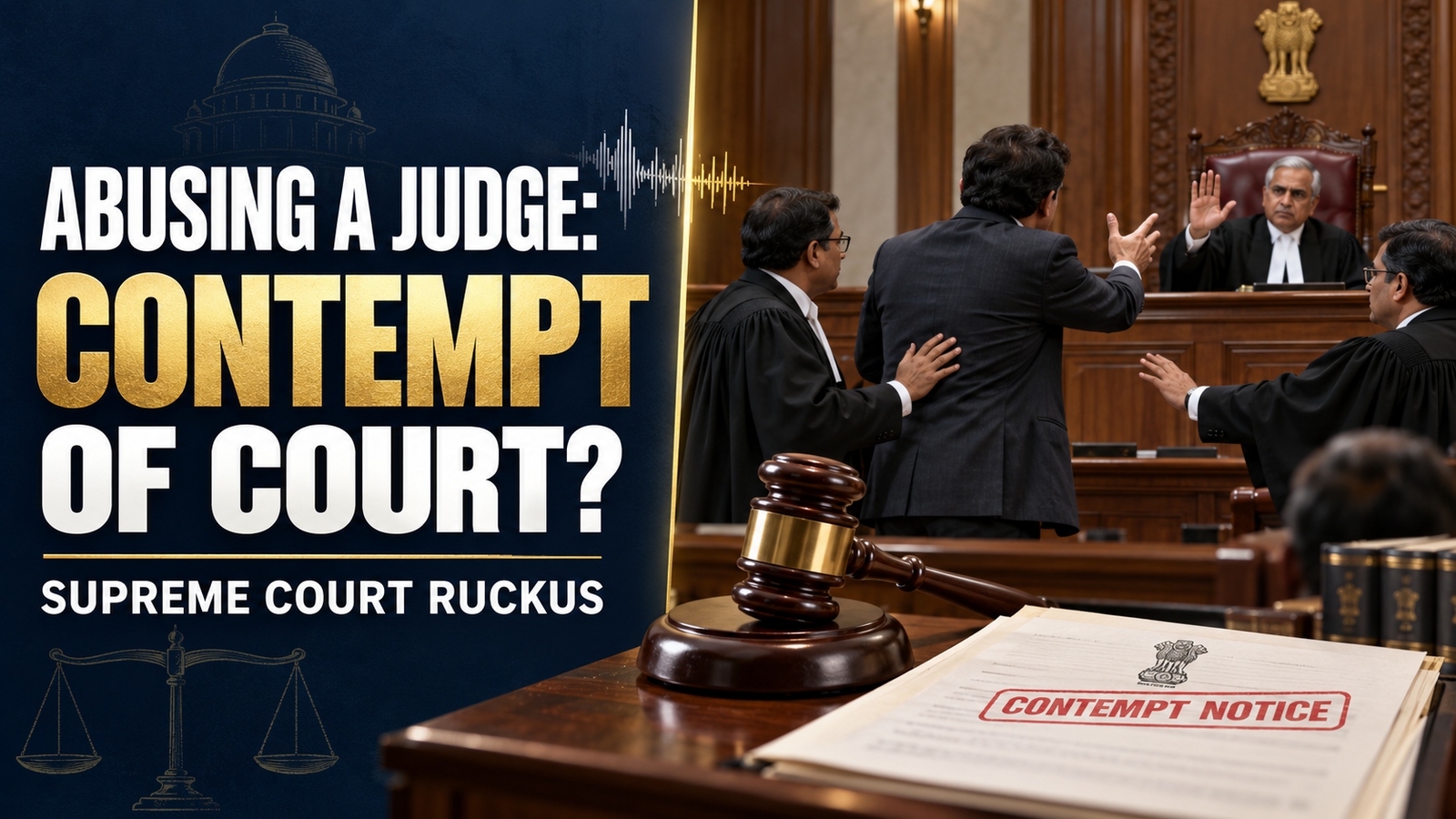
The recent incident inside the Supreme Court of India, where a petitioner appearing in person allegedly abused the Chief Justice of India (CJI) and created a disturbance inside the courtroom, has once again brought the law of Contempt of Court into public discussion. Videos of the incident and media reports sparked an important legal question: Can someone be punished for insulting a judge? Is every criticism of the judiciary contempt? What exactly amounts to contempt of court under Indian law? As an advocate, I often come across these questions. This article explains the concept of Contempt of Court in India in simple language while examining the recent Supreme Court incident from a legal perspective. According to media reports, a party-in-person (petitioner appearing without a lawyer) became agitated during the hearing of his case before the Supreme Court. It is alleged that after the Bench declined to grant the relief sought by him, the petitioner: Started arguing loudly; Abused the Chief Justice of India; Threw papers inside the courtroom; and Disrupted judicial proceedings before security personnel escorted him outside. The incident immediately led to a debate on whether such conduct amounts to criminal contempt of court. Before answering that question, it is important to understand what the law actually says. Simply put, Contempt of Court means any act that: Lowers the authority of the judiciary; Disobeys a court order; or Interferes with the administration of justice. The purpose of contempt law is not to protect the ego of judges. Instead, it exists to preserve public confidence in the judicial system and ensure that courts are able to function independently and effectively. If judicial proceedings can be disrupted without consequences, the administration of justice itself would suffer. Many people are surprised to learn that the power to punish for contempt is not merely created by legislation. The Constitution of India itself grants this power. Declares the Supreme Court to be a Court of Record with the power to punish for contempt of itself. Provides similar powers to every High Court in India. These constitutional provisions are supplemented by the Contempt of Courts Act, 1971, which defines the various kinds of contempt and prescribes the legal framework. Indian law broadly recognizes two categories of contempt: Civil contempt is defined under Section 2(b) of the Contempt of Courts Act, 1971. It generally means: Wilful disobedience of a court's judgment; Wilful violation of an order; Breach of an undertaking given to the court. Suppose a High Court directs a person to vacate a property within 30 days. If the person deliberately refuses to comply despite having the ability to do so, the court may initiate proceedings for civil contempt. The focus here is on non-compliance with court orders. Criminal contempt is defined under Section 2(c) of the Contempt of Courts Act, 1971. It includes acts that: Scandalize or lower the authority of any court; Prejudice or interfere with judicial proceedings; or Obstruct the administration of justice. Unlike civil contempt, criminal contempt is concerned with conduct that affects the functioning or authority of the judiciary. This is perhaps the most common question arising from the recent Supreme Court incident. Based on publicly available reports, the petitioner allegedly: Abused the Chief Justice of India; Shouted inside the courtroom; Threw court papers; and Interrupted judicial proceedings. Conduct of this nature may potentially attract criminal contempt, particularly if it is found to have interfered with judicial proceedings or obstructed the administration of justice. However, whether a particular act legally amounts to contempt is always determined by the court after considering all the facts and following due process. Simply reading news reports is not sufficient to conclude that someone has committed contempt. Only the court can make that determination. Absolutely not. This is one of the biggest misconceptions about contempt law in India. Citizens are free to: Criticize judgments; Discuss court decisions; Publish academic opinions; Disagree with legal reasoning. What crosses the legal line is conduct that intentionally undermines the authority of courts or obstructs the administration of justice. There is a significant difference between: ✅ "I disagree with this judgment." and ❌ "Abusing judges inside a courtroom and disrupting proceedings." The first may be protected criticism. The second may raise questions under contempt law. Courts function differently from ordinary public spaces. Every litigant deserves an opportunity to be heard in a peaceful environment. If parties begin: Shouting inside courtrooms; Threatening judges; Abusing court staff; Creating chaos during hearings, the justice delivery process itself gets affected. That is why courtroom discipline and decorum are considered essential components of the judicial system. Under the Contempt of Courts Act, 1971, a person found guilty of contempt may face: Simple imprisonment up to six months; Fine up to ₹2,000; Or both. The court may also discharge the contemnor or reduce the punishment if an apology is found to be genuine and bona fide. The punishment ultimately depends on the facts and circumstances of each case. Many readers have questioned why immediate contempt action was reportedly not initiated. The answer lies in judicial discretion. Every instance of alleged contempt does not automatically result in punishment. Courts consider several factors, including: The seriousness of the conduct; Whether judicial proceedings were actually obstructed; The intention of the individual; The larger interests of justice. The exercise of contempt jurisdiction is meant to protect the administration of justice—not to react emotionally to criticism or misconduct. The recent Supreme Court incident serves as an opportunity to understand what Contempt of Court in India actually seeks to protect. The objective of contempt jurisdiction is: To preserve the authority of courts; To ensure the smooth functioning of judicial proceedings; To maintain public confidence in the justice delivery system. Every citizen has the right to question judgments, seek legal remedies, and express reasoned criticism. However, these rights carry corresponding responsibilities. Respect for courtroom procedure and the administration of justice remains fundamental to the Rule of Law. Conclusion The recent disruption inside the Supreme Court has reminded many people of a legal concept that often makes headlines but is rarely understood. Contempt of Court is not about preventing criticism or protecting judges from disagreement. It is a constitutional mechanism designed to ensure that justice can be administered without fear, obstruction, or disruption. As lawyers often tell clients: The courtroom is a place for legal arguments—not anger. The strength of any justice system lies not only in its judgments but also in the respect shown to the institution through which those judgments are delivered. Yes. Fair and reasoned criticism of judicial decisions is permissible under Indian law. Not automatically. Whether particular conduct amounts to contempt depends on the facts and is ultimately decided by the court. Civil contempt generally involves wilful disobedience of court orders, whereas criminal contempt concerns acts that interfere with the administration of justice or undermine the authority of the courts. Yes. The law applies equally to advocates, litigants, government authorities, journalists, public officials, and private citizens.What Happened in the Supreme Court?
What Is Contempt of Court in India?
Constitutional Basis of Contempt Powers
Article 129
Article 215
Types of Contempt of Court in India
1. Civil Contempt
Example of Civil Contempt
2. Criminal Contempt
Can Abusing a Judge Amount to Criminal Contempt?
Is Every Criticism of Judges Contempt of Court?
Why Does the Law Protect Courtroom Decorum?
Punishment for Contempt of Court in India
Why Didn't the Supreme Court Immediately Punish the Petitioner?
Key Takeaways
Can a person criticize a Supreme Court judgment?
Is abusing a judge always contempt of court?
What is the difference between civil and criminal contempt?Can a common person be punished for contempt of court?
Judge Abuse and Contempt of Court: Supreme Ruckus