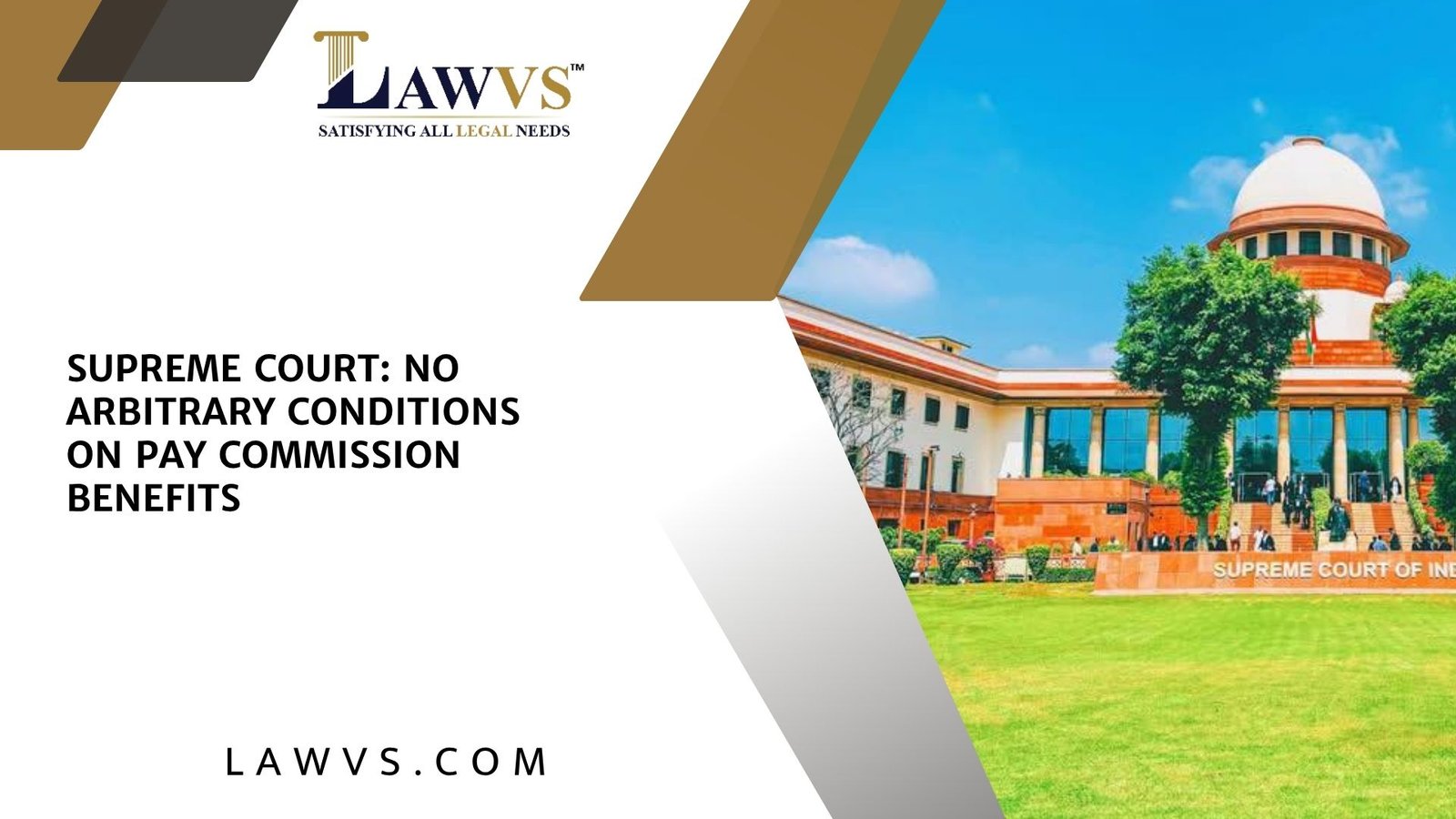
No Arbitrary Conditions for Pay Commission Benefits: Supreme Court Reaffirms Employee Rights
Introduction
In a significant ruling, the supreme court of India held that benefits recommended under pay commissions cannot be denied to employees by imposing additional conditions not provided for in official rules or notifications.
Background
Pay commissions are periodically constituted to revise salaries and benefits of government employees. Their recommendations, once accepted by the government, are implemented through official resolutions. However, disputes often arise when authorities introduce new eligibility criteria, limiting access to these benefits.
Court’s observation
Rejecting the stance of the authorities, the Court held that once a policy decision has been taken, it must be implemented in its entirety. It observed that introducing additional conditions not provided for in the policy framework amounts to changing the rules of the game after it has already begun. The bench further stated that administrative instructions cannot override or dilute officially approved policy decisions.
Key Concerns Highlighted
The Court underlined several concerns arising from such practices:
•Arbitrariness: Imposing extra conditions leads to unfair and inconsistent application of benefits.
•Discrimination: Similarly placed employees may receive unequal treatment, violating constitutional guarantees of equality.
•Increased Litigation: Such actions often force employees to approach courts, burdening the judicial system.
•Erosion of Trust: Frequent policy deviations reduce confidence in administrative fairness.
Legal Implications
The ruling reinforces the principle that executive authorities must act within the boundaries of notified policies. It clarifies that benefits granted under Pay Commission recommendations carry legal enforceability once implemented.The judgment is expected to serve as a precedent in service law matters, especially in cases involving salary revisions, pensions, and allowances. It also sends a strong message against arbitrary administrative practices.
Conclusion
Reaffirming the rights of employees, the Supreme Court of India directed that Pay Commission benefits must be granted as provided for in official notifications, without introducing artificial barriers.The decision highlights the need for transparency, consistency, and accountability in governance, ensuring that employees receive the benefits they are rightfully entitled to without unnecessary restrictions.