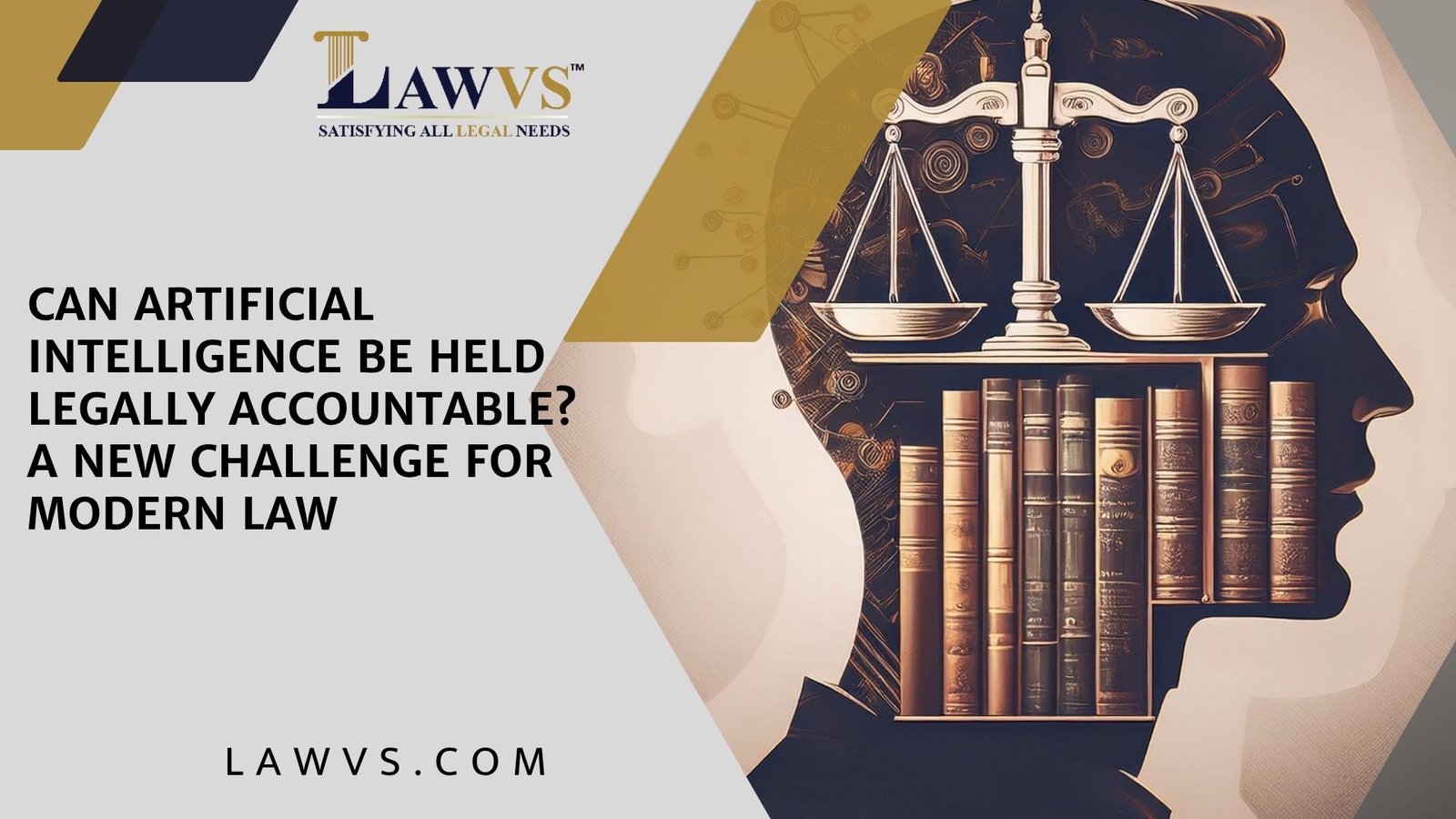
Can Artificial Intelligence Be Held Legally Accountable? A New Challenge for Modern Law
Introduction
The rapid expansion of artificial intelligence has fundamentally transformed the way decisions are made in modern societies, raising serious legal questions about accountability and responsibility. Technologies developed by companies such as OpenAI and Google are now deeply embedded in sectors like healthcare, finance, employment, and even criminal justice. While these systems promise efficiency and innovation, they also introduce significant risks, particularly when automated decisions result in harm. This has led to an increasingly urgent legal debate: when an AI system causes damage or violates rights, who should be held accountable under the law?
Background and Evolution of AI Regulation
Artificial intelligence was initially developed as a tool to assist human decision-making, but it has rapidly evolved into systems capable of operating with minimal human intervention. Traditional legal frameworks were not designed to deal with autonomous or semi-autonomous systems, and therefore struggle to address the complexities introduced by AI. Recognizing this gap, jurisdictions such as the European Union have begun developing regulatory frameworks, including the proposed AI Act, which seeks to classify AI systems based on risk and impose stricter obligations on high-risk applications. Despite these developments, there is still no uniform global legal standard, leading to inconsistencies and regulatory uncertainty.
Legal Challenges in Assigning Liability
One of the most significant challenges posed by AI is the difficulty in assigning legal responsibility. Unlike human actors, AI systems lack intent, consciousness, and legal personality, which are central elements in most legal systems. When an AI system produces a harmful outcome, liability may potentially be attributed to developers, deploying companies, or users. However, the complexity of machine learning systems often makes it difficult to trace how a particular decision was made, a problem commonly referred to as algorithmic opacity or the “black box” issue. This creates serious challenges in proving fault, negligence, or intent, thereby complicating the application of existing legal doctrines.
Judicial Developments and Case Law
Courts across jurisdictions have begun to confront issues related to automated decision-making and algorithmic bias, even if not always directly involving fully autonomous AI. In the case of Loomis v. Wisconsin, the use of a risk assessment algorithm in sentencing raised concerns about transparency and fairness, with the court acknowledging the limitations of relying on proprietary algorithms while still allowing their use under caution. Similarly, in State v. Loomis, the court recognized that while such tools could assist judicial decision-making, they must not replace judicial discretion or violate due process.
In Europe, the case of Data Protection Commissioner v. Facebook Ireland and Maximillian Schrems, decided by the Court of Justice of the European Union, highlighted the importance of data protection and privacy in the digital age, which directly impacts AI systems that rely on large datasets. The judgment emphasized that technological advancement cannot come at the cost of fundamental rights. These cases collectively demonstrate that courts are beginning to engage with the legal implications of automated systems, though a comprehensive framework for AI accountability is still evolving.
Ethical and Constitutional Concerns
The integration of AI into decision-making processes has also raised serious ethical and constitutional issues. Instances of algorithmic bias in hiring practices, credit scoring, and law enforcement have shown that AI systems can replicate and even amplify existing social inequalities. This raises concerns regarding the right to equality, non-discrimination, and due process. If individuals are denied opportunities or subjected to adverse decisions based on opaque algorithms, it becomes difficult to challenge such outcomes effectively, thereby undermining the principles of natural justice.
Debate on Legal Personality and Accountability
A significant debate in legal scholarship revolves around whether AI systems should be granted some form of legal personality. Proponents argue that recognizing AI as a legal entity could simplify liability issues, particularly in cases where harm cannot be directly attributed to a specific human actor. However, critics strongly oppose this idea, contending that granting legal personality to AI would dilute human accountability and allow corporations to evade responsibility. Most legal systems continue to maintain that responsibility must ultimately lie with human actors, whether developers, operators, or organizations deploying AI technologies.
Enforcement and Global Challenges
Even where regulatory frameworks are being developed, enforcement remains a major challenge. AI systems often operate across borders, creating jurisdictional complexities and making it difficult to apply national laws effectively. Additionally, the pace of technological advancement far exceeds the speed at which legal systems can adapt, resulting in a persistent regulatory gap. This creates a situation where innovation continues to expand, while legal accountability struggles to keep up.
Conclusion
The question of whether artificial intelligence can be held legally accountable reflects a broader transformation in the relationship between law and technology. While AI offers immense potential, it also exposes the limitations of traditional legal frameworks that were designed for human actors. Judicial decisions and emerging regulations indicate that legal systems are beginning to adapt, but significant challenges remain. Ultimately, accountability for AI-driven actions cannot rest with machines themselves but must be traced back to human decision-makers and institutions. As technology continues to evolve, the law must also develop robust mechanisms to ensure that innovation does not come at the cost of justice, transparency, and fundamental rights.