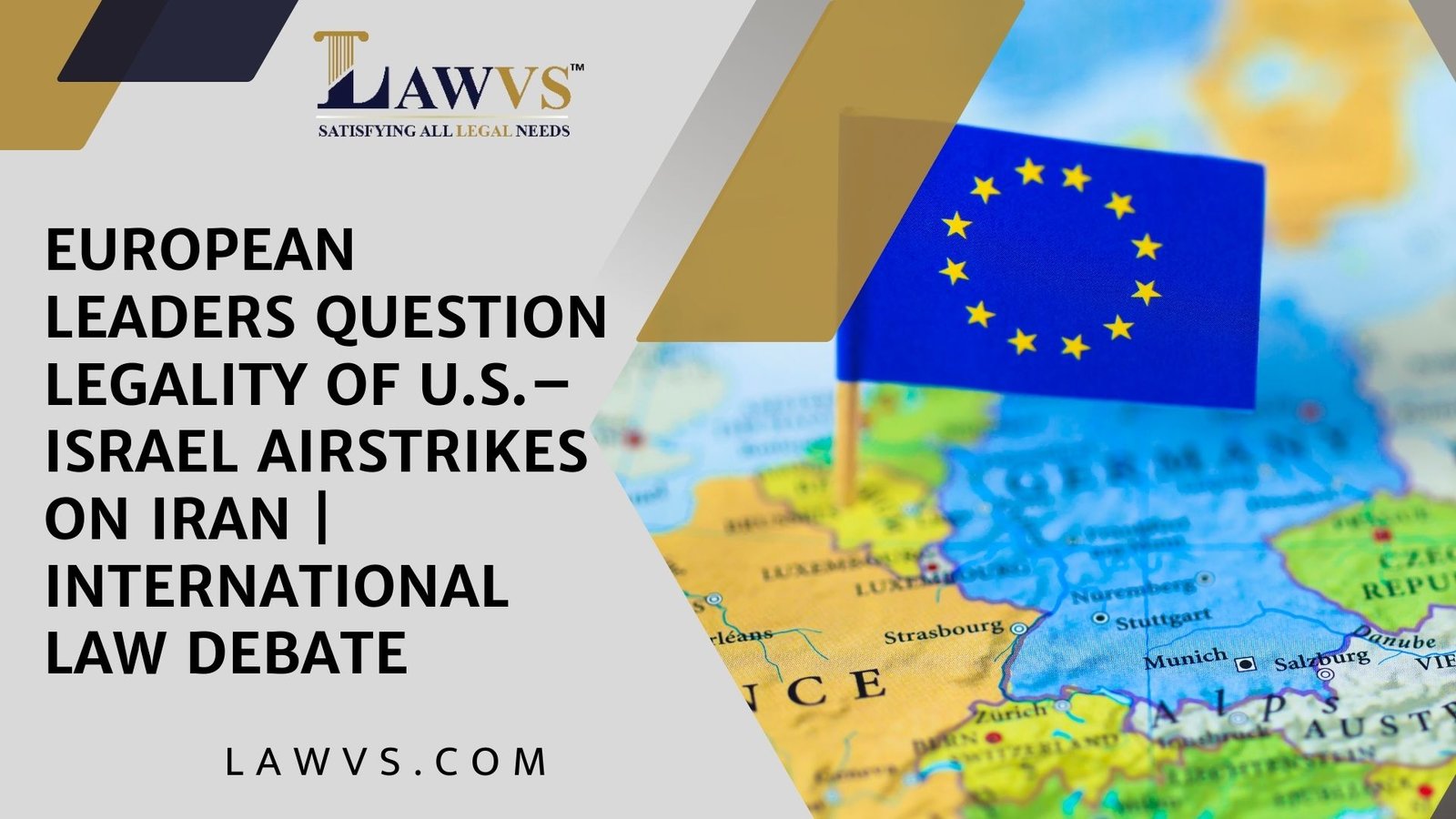
European Leaders Question
Legality of U.S.–Israel Airstrikes on Iran
Growing Political and Legal Concerns in Europe
A number
of European political leaders have raised serious concerns regarding the
legality of recent military airstrikes conducted by the United States
and Israel against targets in Iran. The operation has triggered a
wider international debate on whether the attacks comply with the rules
governing the use of force under the United Nations Charter.
Officials
across Europe have warned that unilateral military actions without clear legal
justification risk undermining the international legal order that has governed
interstate relations since the end of the Second World War.
Switzerland: Airstrikes Violate International Law
One of
the strongest statements came from Martin Pfister, the Defence Minister of Switzerland.
In an
interview with the Swiss newspaper SonntagsZeitung, Pfister stated that
the airstrikes carried out by the United States and Israel constituted a violation
of international law, particularly the prohibition on the use of force.
According
to Pfister, the Swiss Federal Council believes that the attacks breach
the international rule prohibiting military aggression against another
sovereign state.
He stated
that:
“The
Americans and Israel have attacked Iran from the air. In doing so, they, like
Iran, violated international law.”
Pfister
also urged all parties involved in the conflict to immediately halt hostilities
in order to prevent further civilian casualties and regional instability.
Germany Expresses Doubts Over Legal Justification
Concerns
were also expressed in Germany, where Lars Klingbeil, Germany’s
Vice Chancellor and Finance Minister, questioned whether the military campaign
can be justified under international law.
Klingbeil
publicly stated that he has “serious doubts that this war is legitimate
under international law” and made it clear that Germany would not
participate in the conflict. He further warned that such conflicts risk eroding
the international rules-based system, adding that:
“There is
a great danger that we are sliding ever deeper into a world where there are no
longer any rules… We do not want to live in a world where only the law of the
strongest applies.”
The
statement reflects growing concern among European policymakers that military
actions conducted without broad international support could weaken the
authority of international legal institutions.
Spain Condemns the Attacks
Political
leaders in Spain have also criticised the strikes, describing them as reckless
and lacking a legal basis under international law.
Spanish
officials have argued that unilateral military actions without authorization
from the United Nations Security Council or a clear case of self-defence
risk violating the principles established under the UN Charter.
Spain’s
criticism reflects broader concerns among some European governments that the
escalation of the conflict could destabilize the Middle East and undermine
diplomatic efforts aimed at maintaining international peace and security.
Broader European Concerns
Across
Europe, governments are increasingly divided on how to respond to the
escalating conflict. While some countries have called for restraint and
diplomatic negotiations, others have warned that continued military escalation
could have far-reaching consequences, including:
- increased regional
instability in the Middle East
- threats to global energy
security
- weakening of international
legal norms governing the use of force
European
leaders have therefore called for renewed diplomatic engagement and respect for
international law.
Legal Significance
The
controversy surrounding the airstrikes has highlighted a key legal issue under
international law: whether the use of force against another state can be
justified without authorization from the United Nations Security Council
or without a clear case of self-defence under Article 51 of the UN Charter.
Legal
scholars argue that if states increasingly resort to unilateral military
action, it could weaken the global rules-based system established under the United
Nations framework.
Conclusion
The
criticism voiced by European leaders, including officials from Switzerland,
Germany, and Spain, reflects growing global concern about the legal framework
governing the use of force in international relations. As the conflict
continues to unfold, the debate over the legality of the strikes is likely to
remain central in discussions on international law, diplomacy, and global
security.